One billion dollars. That's what Pump.fun — the platform that turned launching meme coins on Solana into a daily ritual for millions of traders — has collected in cumulative fees since January 2024, according to DeFiLlama data updated through July 28, 2026: $1.152 billion in total fees, $1.069 billion in net revenue. In the same period, more than 8 million tokens were created on the platform. Fewer than 2% ever crossed the "bonding curve," the threshold that turns a project from an experiment into a token actually tradable on a decentralized exchange. Nearly all the rest — the overwhelming majority — died within hours, often within minutes.

Meanwhile, a federal lawsuit alleging racketeering (RICO) has sat for five months on the desk of a Manhattan judge who has yet to rule. And while it waits, the platform just posted an opening for a Chief Legal Officer with a salary of up to $5 million a year.
All of this has happened — and keeps happening — without a single line of code breaking the law. That's where this story begins.
The $1B revenue milestone: a machine that doesn't stop
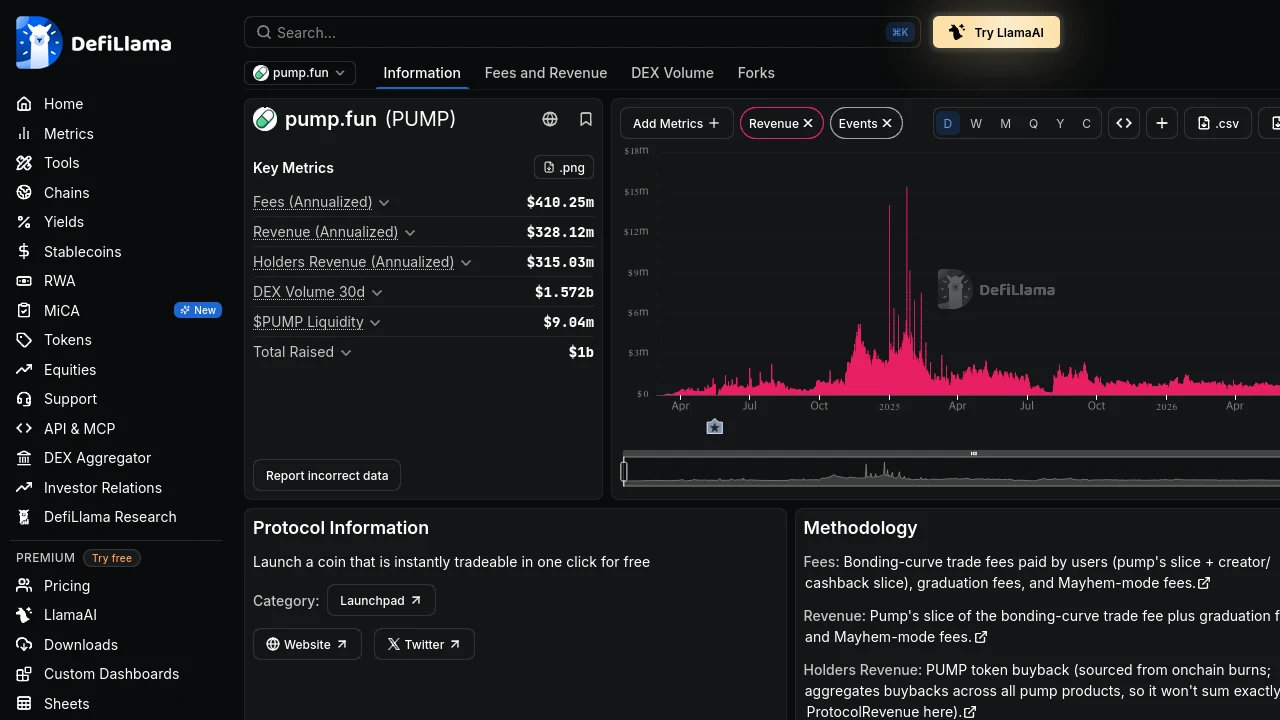
Pump.fun went live on January 19, 2024. In just over two and a half years it became one of the most profitable applications ever built on a blockchain. Its all-time peak remains Q1 2025, when the platform collected $263.82 million in fees in three months — a number no later quarter has matched. From there the curve declined almost linearly: $144.2 million in Q2 2025, then $110.5 million, $100.97 million, $108.3 million in Q1 2026, down to $79.2 million in Q2 2026.
Even in decline, the numbers remain enormous: in the 30 days before July 28, 2026 alone, Pump.fun generated $20.06 million in revenue and $26.19 million in fees, with cumulative trading volume on decentralized exchanges topping $93 billion. In Q1 2026 alone, according to data gathered during this investigation's research phase, Pump.fun accounted for 36% of all revenue generated on the Solana blockchain — a figure that shows just how central the meme-coin economy has become to the ecosystem, not a niche at all.
The business model is as simple as it is ruthless: anyone can launch a token for a fraction of a cent, with no developers, no whitepaper, no audit. Pump.fun takes a fee on every buy and sell along the bonding curve. More trading, more fees. It doesn't matter whether a token survives an hour or a year — the platform gets paid either way.
The bonding curve and the graveyard of 8 million tokens
The technical mechanism behind Pump.fun is called a bonding curve: an algorithm that sets a token's price based on how much SOL has been deposited to buy it. Once the curve collects enough liquidity — historically around $85,000 — the token "graduates" and is automatically listed on a decentralized exchange like Raydium, with locked liquidity.
This is where the numbers turn brutal. Of more than 8 million tokens launched, according to a Solidus Labs analysis cited by CoinEdition on January 4, 2026, 98.6% ended in a rug pull — a sudden abandonment of the project that leaves the last buyers holding worthless tokens. In other words: out of every 1,000 tokens created on Pump.fun, roughly 986 are, in effect, designed to die. Fewer than 2% cross the bonding curve and reach an actual secondary market.
This isn't a bug in the system. It is the system. Anyone can create a token for free, test it for a few minutes, and simply vanish if it doesn't take off. No registration, no obligation to continue, no legal consequence — because, technically, nobody promised anybody anything.
Sniper bots and bundlers: infrastructure that gets there before you do
If you thought buying a meme coin in its first minute of life put you on equal footing with other traders, the data says otherwise. According to a technical investigation by CryptoNews.net published on July 9, 2026, sniper bots capture between 20% and 40% of a new token's total supply before a human trader even manages to see the ticker on screen.
The mechanism is called "bundling" and it exploits Jito, the most widely used block-building infrastructure on Solana: a bundler executes the token's deployment and the first purchase in a single block, in one atomic transaction — zero time gap, zero chance for a normal trader to step in first. By 2026 this practice is no longer seen as a niche edge for insiders — it's become, literally, "basic infrastructure" for anyone launching a token with the goal of dumping it on early buyers at a loss. The same toolkits include "coordinated sell" features that liquidate positions across 15-20 wallets simultaneously, making it impossible for an outside observer to distinguish a single actor from an organized group.
The practical result: when an average user spots a new token on Pump.fun and decides to buy, a large chunk of the cheapest supply is already in the hands of automated wallets ready to sell into the first price spike.
The losses: up to $5.5 billion burned by users
If Pump.fun pocketed over a billion dollars, someone else picked up the tab. According to data reported by CoinEdition on January 4, 2026 — never disputed since — Pump.fun users collectively lost between $4 and $5.5 billion, against platform earnings estimated at the time at $935.6 million. The line that sums up the paradox, echoed in the ongoing lawsuit's own filings, is blunt: "Pump.fun made $935.6 million while users allegedly lost $4-5.5 billion."
A separate report from Bitcoin Insider, cited during this investigation's late-July research, estimates that more than 60% of wallets that traded on Pump.fun closed in net loss. There's another detail that matters: before the fee cuts introduced in Q1 2026, token creators — the people who actually launched the projects — split just $60 million in total among themselves, or 6.5% of the platform's revenue. The other 93.5% stayed with Pump.fun. Only after community backlash did the platform lower its flat 1% fee to a sliding scale between 0.05% and 0.95%.
In February 2026, according to a CoinAlertNews report, the platform's founders also sold $10 million worth of PUMM tokens during a market downturn — a detail that, combined with the lawsuit's formal allegation that the founders used privileged access to buy new tokens ahead of the public and then resell them to retail traders, fuels suspicion of a structural conflict of interest between those running the platform and those betting their own money on it.
Aguilar v. Baton Corporation: five months of silence in Manhattan
The lawsuit that weighs heaviest on Pump.fun's future is Aguilar v. Baton Corporation Ltd., filed January 30, 2025 in the U.S. District Court for the Southern District of New York under case number 1:25-cv-00880. Baton Corporation is the entity that operates Pump.fun.
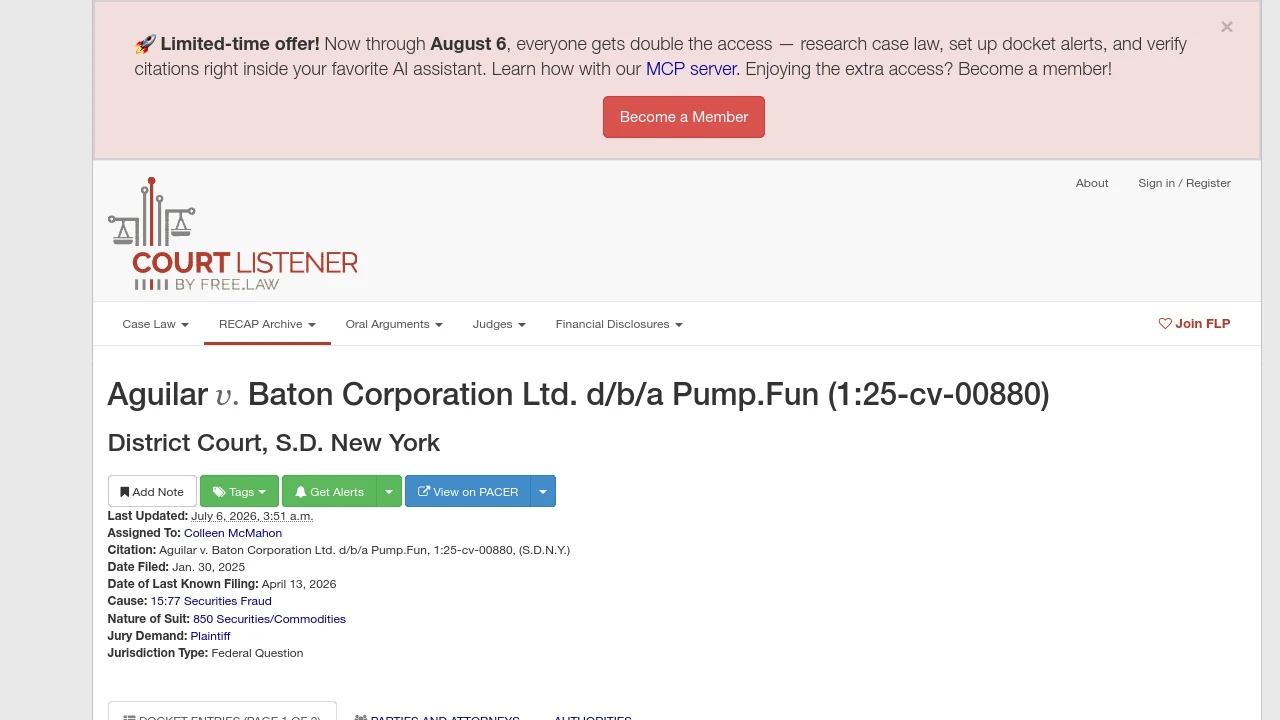
The court timeline, reconstructed from public filings on CourtListener and updates from plaintiffs' counsel Wolf Popper and Burwick Law, is dense: on June 25, 2025, Judge Colleen McMahon consolidated the Aguilar case with a related suit (Carnahan), naming Michael Okafor as lead plaintiff. On July 22-23, 2025, a first amendment added RICO claims — the federal law built to target organized crime — and expanded the defendant list to include Solana Labs, Jito Labs, and 14 new individual defendants, among them Anatoly Yakovenko (CEO of Solana Labs) and Lucas Bruder (CEO of Jito Labs).
In September 2025, a confidential informant filed 5,000 internal chat logs with the court, prompting the judge to allow a further amendment. On January 7, 2026, the Second Amended Consolidated Complaint arrived, this time backed by 15,000 internal messages submitted as evidence. On March 9, 2026, Pump.fun and its co-defendants formally filed their Motion to Dismiss, seeking to have the case thrown out for lack of jurisdiction and arguing that tokens launched on the platform don't qualify as "securities" under federal law.
Since then, silence. The last known filing dates to April 13, 2026 — likely the plaintiffs' response to the dismissal motion. A prediction market built specifically around the question "will the SDNY court rule on the Motion to Dismiss by July 18, 2026?" resolved with a flat no. As of this writing, more than five months have passed since briefing on the motion closed (on February 20, 2026) with no ruling from Judge McMahon. It's important to be precise here: the RICO claims remain just that — allegations made by plaintiffs, not facts established by a court. But their mere existence, combined with such a long wait for even a preliminary decision, points to a level of legal risk the platform cannot ignore.
The detail that speaks for itself: a $5 million-a-year CLO
And here's the most telling detail in the whole story. In June 2026, with the Motion to Dismiss still pending after months, Baton Corporation posted a job opening for a Chief Legal Officer with compensation between $1 and $5 million a year, according to FinanceFeeds. The role, per the job description, explicitly covers relations with the SEC, CFTC, FinCEN, OFAC, the EU's MiCA framework, the UK's FCA, and regulators across Asia-Pacific, along with direct oversight of investigations, litigation, and law enforcement requests.
In the same posting, Baton Corporation claims over $300 million in daily volume and more than $500 million in profit in 2025 alone, with roughly 100 employees. A company of that size offering a Wall Street-executive-level salary for a single legal role — while facing a RICO case with a dismissal motion still hanging in the balance — is no coincidental detail. It's an investment that signals just how seriously the company is taking its own legal exposure, regardless of how the ongoing case is eventually resolved.
Pump.fun GO: when a bounty becomes a dangerous incentive
This isn't the first time Pump.fun has made headlines for reasons that go beyond finance. In November 2024 the platform was already under fire for extreme content broadcast via live streaming — self-harm, animal cruelty, racist content — spread through the live-streaming features built into token launches.
In 2026 the pattern repeated with Pump.fun GO, a "bounty" marketplace promising SOL payouts to anyone completing tasks to promote tokens. Among the controversies that surfaced: users paid to get promotional tattoos on their faces, and — the most serious case — a roughly $700,000 bounty offered to whoever live-streamed their own suicide, later pulled from the platform after backlash. This isn't the first time a financial incentive on Pump.fun has pushed the line between toxic entertainment and real harm to people — and it's a pattern repeating itself two years apart, a sign that internal controls haven't changed enough.
The regulatory paradox: banned in London, free in New York
We close with the detail that perhaps best captures the gray zone Pump.fun operates in. On December 3, 2024, the UK's FCA, the country's financial watchdog, declared Pump.fun "unauthorized" for British users — meaning it lacked the licenses required to offer financial services in the country. Pump.fun responded the same day by blocking UK access. The FCA's reasoning was blunt: the platform was offering financial services without authorization, leaving users with no protection scheme whatsoever in the event of losses.
On social media, commentator Mario Nawfal summed up the problem in a line that went viral: Pump.fun's business model "relied on organizing mass buys to pump crypto prices, often leaving retail investors holding the bag" — an informal description, but one that captures the core of the bonding-curve-and-sniper-bot mechanism described above.
And yet, banned in London, the platform keeps operating in New York, posting record revenue and even expanding: in May 2026 Pump.fun launched multichain trading on Ethereum, Base, and BNB Chain, using a single wallet and SOL as the settlement currency, with no bridge required. One market considers it too risky for its own citizens. Another lets it grow unchecked, while a court — five months on — decides whether any of the allegations hold up.
Meanwhile, the billion-dollar counter keeps ticking. And the 8 million dead tokens sit there, in Solana's on-chain graveyard, silent proof of how fast an experiment that became an industry can turn into a mechanism some call innovation — and others, simply, a trap.
Sources: DeFiLlama (7/28/2026), CoinEdition (1/4/2026), Solidus Labs, CryptoNews.net (7/9/2026), Bitcoin Insider, CoinAlertNews, CourtListener docket 69593359, Burwick Law, Wolf Popper, Law360 (3/9/2026), FinanceFeeds (June 2026), BeInCrypto, CryptoTimes (5/26/2026). Lawsuit: Aguilar v. Baton Corporation Ltd., SDNY 1:25-cv-00880, Judge Colleen McMahon.
Related Reading
By Segugio — Market Analyst at BitcoinMarket.net.
Published: 2026-08-11 | Last updated: 2026-08-11